

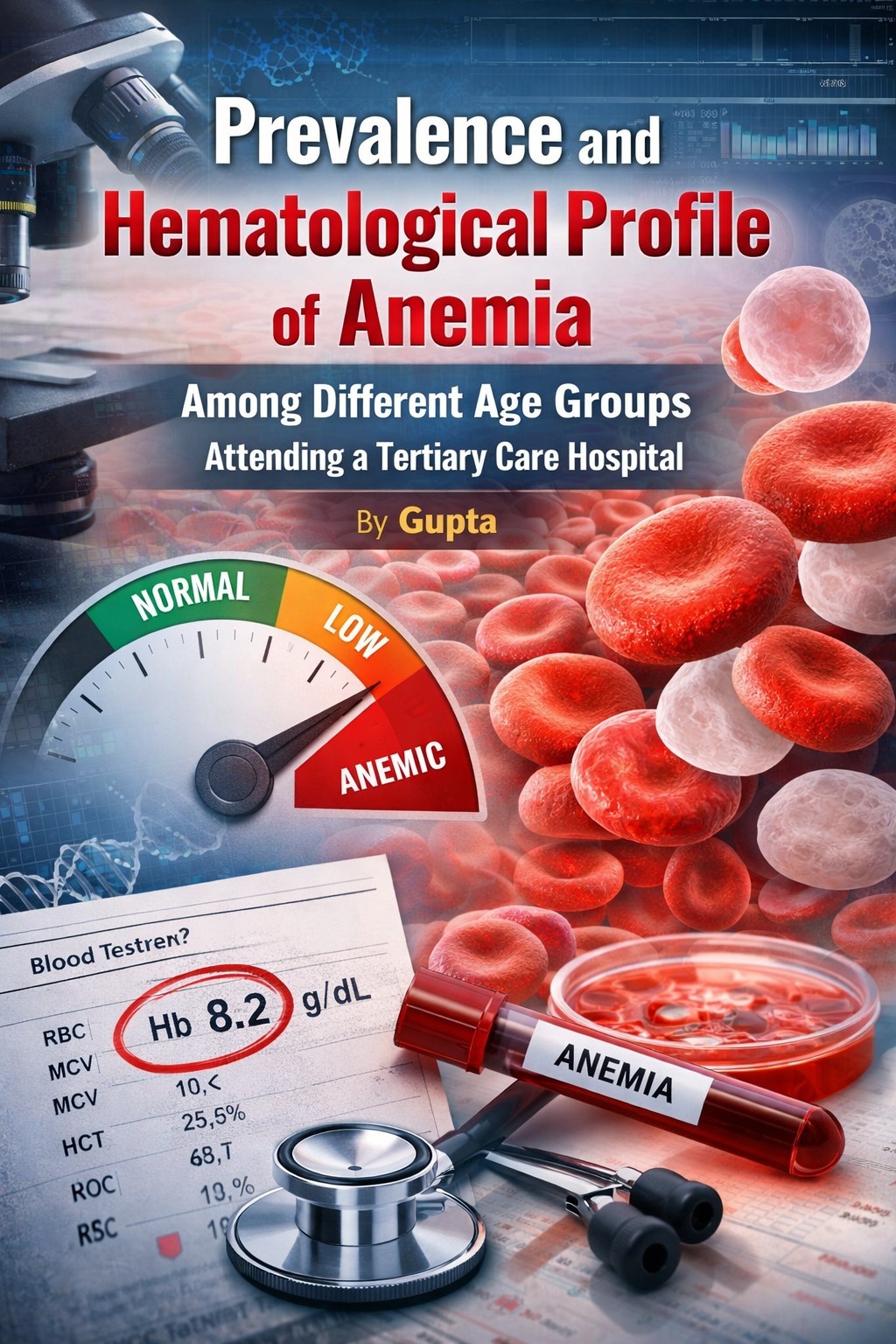
Prevalence and Hematological Profile of Anemia Among Different Age Groups Attending a Tertiary Care Hospital
Authors
Files
Key Information
Journal
Published in Vol. 1 No. 1 (2026) of Research Edge International Journal of Multidisciplinary Studies.
Research Edge International Journal of Multidisciplinary Studies is a peer-reviewed international journal dedicated to publishing high-quality research articles across diverse academic disciplines including science, medicine, engineering, social sciences, and humanities. The journal aims to promote interdisciplinary research and academic excellence.
About the JournalAbstract
Anemia is a common hematological disorder and a significant public health concern, especially in developing countries. It affects individuals of all age groups and is associated with reduced work capacity, impaired cognition, and increased morbidity. This hospital-based descriptive cross-sectional study was conducted to determine the prevalence of anemia and evaluate the hematological profile of anemic patients across different age groups attending a tertiary care teaching hospital.
A total of 200 subjects referred for routine hematological investigations were included. Hemoglobin estimation, complete blood count, red cell indices, and peripheral blood smear examination were performed using standard laboratory procedures. Anemia was classified according to World Health Organization criteria based on age- and sex-specific hemoglobin cut-off values.
Out of 200 subjects, 132 (66%) were found to be anemic. The highest prevalence was observed among children and adolescents (77.4%), followed by adults (60.8%) and the elderly (61.1%). Females showed a higher prevalence (73.9%) compared to males (59.3%). Moderate anemia was the most common severity (45.5%). The mean hemoglobin level among anemic subjects was 9.1 ± 1.8 g/dL. Red cell indices and peripheral smear findings indicated that microcytic hypochromic anemia was the predominant morphological type.
Significant variation in hematological parameters across age groups (p < 0.05) highlights the importance of age-wise evaluation for accurate diagnosis and management. The study underscores the value of routine hematological screening for early detection and classification of anemia to improve patient care and preventive strategies.
References
1. “60th Annual Conference of Indian Society of Hematology & Blood Transfusion (ISHBT) October 2019.” Indian Journal of Hematology and Blood Transfusion, vol. 35, no. S1, Oct. 2019, pp. 1–151, https://doi.org/10.1007/s12288-019-01207-5.
2. “62nd Annual Conference of the Indian Society of Gastroenterology, February 10th – 13th, 2022, Pune.” Indian Journal of Gastroenterology, vol. 41, no. S1, Feb. 2022, pp. 1–178, https://doi.org/10.1007/s12664-021-01234-z.
3. Anderson, Jeffrey L., et al. “ACC/AHA 2007 Guidelines for the Management of Patients With Unstable Angina/Non–ST-Elevation Myocardial Infarction.” Circulation, vol. 116, no. 7, Aug. 2007, https://doi.org/10.1161/CIRCULATIONAHA.107.181940.
4. Fiocchi, Alessandro, et al. “World Allergy Organization (WAO) Diagnosis and Rationale for Action against Cow’s Milk Allergy (DRACMA) Guidelines.” World Allergy Organization Journal, vol. 3, no. 4, 2010, pp. 57–161, https://doi.org/10.1097/WOX.0b013e3181defeb9.
5. Kumar, Pradeep, et al. “Socio-Economic Inequality in Anaemia among Men in India: A Study Based on Cross-Sectional Data.” BMC Public Health, vol. 21, no. 1, Dec. 2021, p. 1345, https://doi.org/10.1186/s12889-021-11393-5.
6. Let, Subhojit, et al. “Prevalence and Determinants of Anaemia among Women of Reproductive Age in Aspirational Districts of India: An Analysis of NFHS 4 and NFHS 5 Data.” BMC Public Health, vol. 24, no. 1, Feb. 2024, p. 437, https://doi.org/10.1186/s12889-024-17789-3.
7. Meschia, James F., et al. “Guidelines for the Primary Prevention of Stroke.” Stroke, vol. 45, no. 12, Dec. 2014, pp. 3754–832, https://doi.org/10.1161/STR.0000000000000046.
8. Pagels, Agneta A, et al. “Health-Related Quality of Life in Different Stages of Chronic Kidney Disease and at Initiation of Dialysis Treatment.” Health and Quality of Life Outcomes, vol. 10, no. 1, 2012, p. 71, https://doi.org/10.1186/1477-7525-10-71.
9. Piel, Frédéric B., et al. “Global Burden of Sickle Cell Anaemia in Children under Five, 2010–2050: Modelling Based on Demographics, Excess Mortality, and Interventions.” PLoS Medicine, vol. 10, no. 7, Jul. 2013, p. e1001484, https://doi.org/10.1371/journal.pmed.1001484.
10. Safiri, Saeid, et al. “Burden of Anemia and Its Underlying Causes in 204 Countries and Territories, 1990–2019: Results from the Global Burden of Disease Study 2019.” Journal of Hematology & Oncology, vol. 14, no. 1, Nov. 2021, p. 185, https://doi.org/10.1186/s13045-021-01202-2.
11. Shovlin, Claire L, et al. “British Thoracic Society Clinical Statement on Pulmonary Arteriovenous Malformations.” Thorax, vol. 72, no. 12, Dec. 2017, pp. 1154–63, https://doi.org/10.1136/thoraxjnl-2017-210764.
12. Stauder, Reinhard, et al. “Prevalence and Possible Causes of Anemia in the Elderly: A Cross-Sectional Analysis of a Large European University Hospital Cohort.” Clinical Interventions in Aging, Jul. 2014, p. 1187, https://doi.org/10.2147/CIA.S61125.
13. Tomblyn, Marcie, et al. “Guidelines for Preventing Infectious Complications among Hematopoietic Cell Transplantation Recipients: A Global Perspective.” Biology of Blood and Marrow Transplantation, vol. 15, no. 10, Oct. 2009, pp. 1143–238, https://doi.org/10.1016/j.bbmt.2009.06.019.
14. Velleca, Angela, et al. “The International Society for Heart and Lung Transplantation (ISHLT) Guidelines for the Care of Heart Transplant Recipients.” The Journal of Heart and Lung Transplantation, vol. 42, no. 5, May 2023, pp. e1–141, https://doi.org/10.1016/j.healun.2022.10.015.
15. Weiss, Scott L., et al. “Surviving Sepsis Campaign International Guidelines for the Management of Septic Shock and Sepsis-Associated Organ Dysfunction in Children.” Intensive Care Medicine, vol. 46, no. S1, Feb. 2020, pp. 10–67, https://doi.org/10.1007/s00134-019-05878-6.
Details
License
Copyright (c) 2026 Ayush Gupta

This work is licensed under a Creative Commons Attribution-NonCommercial-NoDerivatives 4.0 International License.
All articles published in Research Edge International Journal of Multidisciplinary Studies are licensed under a Creative Commons Attribution 4.0 International License (CC BY 4.0).
This license permits unrestricted use, distribution, and reproduction in any medium, provided the original author and source are properly credited.
Authors retain copyright of their work and grant the journal the right of first publication.